Digital Marketing for Small Business: Where to Start

Digital Marketing for Small Business: Where to Start

A small business gets the most leads by showing up where customers are already looking, in this order: Google Business Profile, a website that appears in search, useful content, one or two social networks and only then paid ads.

This order brings the most enquiries for the least money, because each step builds on the previous one. An ad that leads to a slow site with no clear contact burns budget, while the same ad leading to a well built page brings calls.

You do not have to be everywhere. It is enough to be accurate, fast and easy to reach in a few places, and to know which channel actually brings you work.

Below are five steps a small business can take on its own or with a team, plus a way to measure whether it all really works.

We describe each step the way we do it on client projects, with no promises nobody can keep.
Five steps at a glance

01Google profile

A free listing on Google Maps with accurate details, photos and reviews.

02Website

Fast on mobile, with a separate page for each service and clear contact options on every screen.

03Content

Articles that answer the questions customers ask you on the phone.

04Social media

One or two networks where your customers are, with regular posts.

05Ads

Google and Meta campaigns only once the site and profile reliably turn visits into leads.

06Measurement

Number of leads, their source and closed deals, month by month.

Steps 1 and 2: Google profile and a website Google understands

Steps 1 and 2: Google profile and a website Google understands

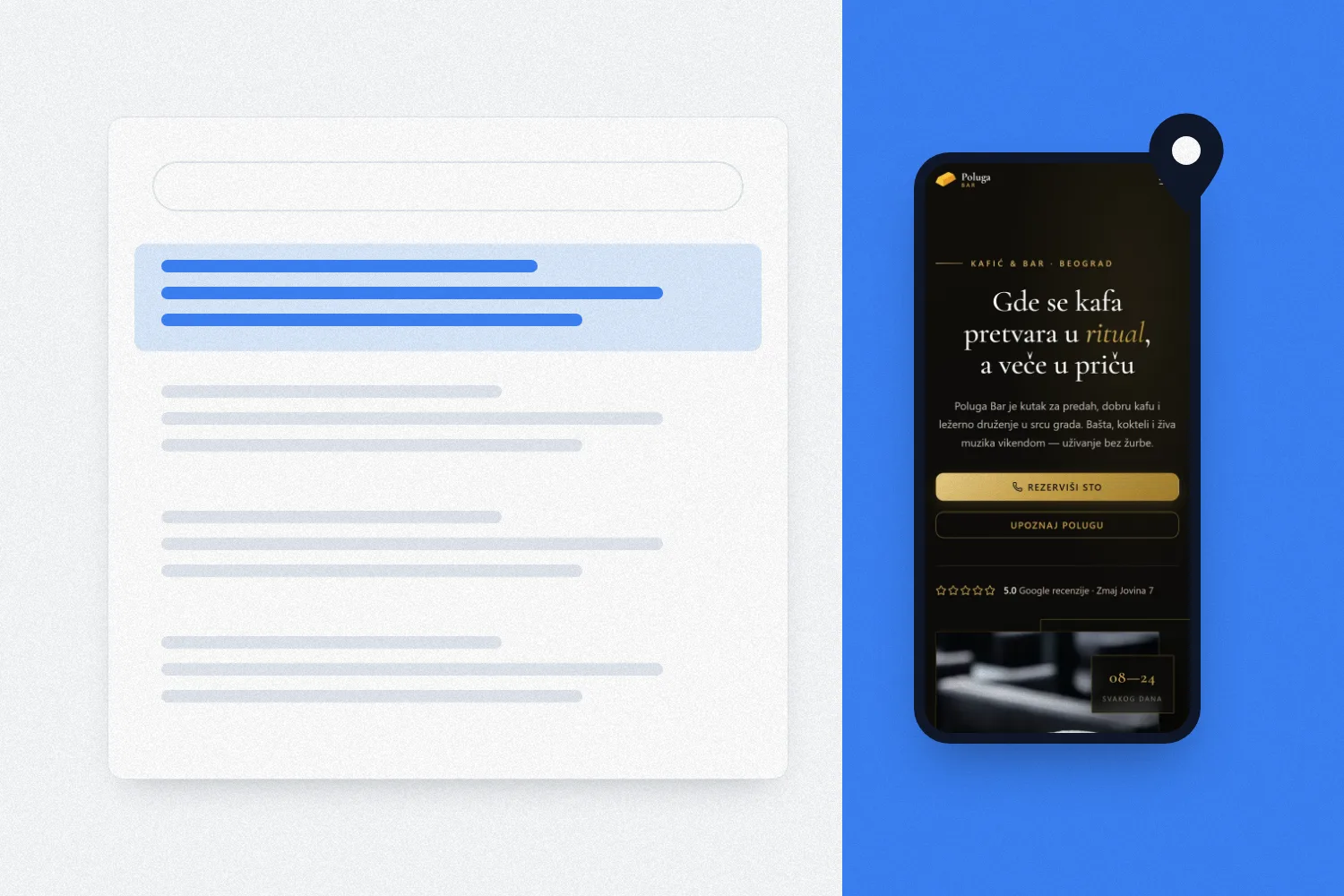
When someone searches for “plumber near me” or “accountant in my city”, they first see a map with a few businesses. Those businesses have a complete Google profile, and it costs nothing.

Create or claim your listing on Google Business Profile. Enter the exact name, address or service area, phone, opening hours and main category, and keep those details identical on your website and social profiles.

Add real photos of your work and premises, not stock images. Ask happy customers to leave a review and reply to every one, including the bad ones, calmly and specifically.

The profile sends people to your website. The site should be fast on a phone, every service should have its own page, and every page should say right away what you do, where and how to contact you.

Google understands a site better when it has clear headings, page descriptions and structured data. That is technical SEO done properly once, and it helps every step that follows.

Steps 3 to 5: content, social media and paid ads

Steps 3 to 5: content, social media and paid ads

Write answers to the questions customers ask you on the phone: how long it takes, how much it costs, which option is better. Each article is another chance to be found on Google, and one good article a month is worth more than ten weak ones.

Pick one or two social networks where your customers spend time. For consumer services that is usually Instagram and Facebook, for B2B services LinkedIn. Regular posts on one network beat occasional posts on five.

Google Ads bring people who are already searching for your service, while Instagram and Facebook ads reach people who do not know you yet. Both make sense only when the site and profile turn visits into calls, otherwise you pay for clicks that bring nothing.

For a campaign, a dedicated landing page often works better than the homepage: one offer, one clear call to action and tracking of every lead.

A real example: for the private hospital Medical Time we set up GA4 and Google Tag Manager, plus more than 370 negative keywords in Google Ads to cut irrelevant searches. The best campaigns reached up to 54% lower cost per conversion than the account average.

How to measure whether it works

How to measure whether it works

Track three numbers: how many calls and messages you get, where they came from and how many jobs you closed from them. Everything else, such as likes and views, is supporting data.

Google Analytics and Google Search Console are free. Analytics shows where visitors come from and what they do on the site, Search Console shows which searches you appear for and how many people click.

For accurate numbers, phone taps, form submissions and WhatsApp or Viber messages should be recorded as conversions. With ads, you then see exactly what one lead costs.

Once a month, review the results, scale what brings leads and switch off what only spends money. A small budget with regular measurement achieves more than a large one without it.

Why digital marketing with IT Expert

01Direct work with developers

You talk to people who understand both technology and business, with no middlemen.

02Everything in one place

Consulting, websites, digital marketing and technical support, without switching between agencies.

03SEO from the start

Sites are built fast and search ready, with a technical SEO audit and structured data.

04Campaigns with measurement

Google Ads and Meta campaigns with analytics and conversion tracking, so you know the cost of every lead.

05Monthly report

A regular review of results and campaign optimization, in plain language.

06Verifiable results

On the Medical Time project, Semrush Site Health rose from 90% to 98% in one week and errors dropped from 6 to 0.

Frequently asked questions

Usually months rather than weeks, depending on competition and the state of the site. That is why it makes sense to start now and use paid ads until organic results grow.
Start with a small budget, measure what one lead costs, then increase what brings work. Without conversion tracking you cannot tell whether the budget was well spent.
Yes. Instagram is good for showing your work, but the Google profile and ads work best when they lead to a site with clear services and contact options. A website is also the only channel you fully own.
Wherever your customers are. For consumer services usually Instagram and Facebook, for B2B services LinkedIn. One network with regular posts is better than five neglected ones.
An owner can manage the Google profile, posts and basic content alone. Technical SEO, conversion tracking setup and running ads take more knowledge and time, and that is where help pays off most.
We run Google Ads and Meta campaigns, build a content strategy, set up analytics and conversion tracking and send a monthly report with recommendations. To start, write to us via the Contact page or at kontakt@itexpert.rs and request a quote.